
Kansas
State Protections and Legal Framework
-
State constitutional guarantees regarding right to education
Article 6 (Education) of the Constitution of the State of Kansas requires the legislature to provide for (1) “intellectual, educational, vocational and scientific improvement by establishing and maintaining public schools, educational institutions and related activities” and (2) “a state board of education which shall have general supervision of public schools, educational institutions and all the educational interests of the state.” (See Sections 1 and 2 of Article 6 (Education) of the Constitution of the State of Kansas.)
Case law and legislative history defining and interpreting the right to education
Brown v. Board of Education, 347 U.S. 483 (1954) (USSC+) - On May 17, 1954, U.S. Supreme Court Justice Earl Warren delivered the unanimous ruling that the segregation of white and Negro children in the public schools of a State solely on the basis of race was a violation of the 14th amendment and was therefore unconstitutional.
State constitutional protections regarding non-discrimination and equity
Article 10 (Kansas Acts Against Discrimination) of the Kansas Act declared that “the policy of the state of Kansas [is] to eliminate and prevent discrimination in all employment relations, to eliminate and prevent discrimination, segregation, or separation in all places of public accommodations… and to eliminate and prevent discrimination, segregation or separation in housing.” In addition, the policy of Kansas is to “assure equal opportunities and encouragement to every citizen regardless of race, religion, color, sex, disability, national origin or ancestry, in securing and holding, without discrimination, employment in any field of work or labor for which a person is properly qualified, to assure equal opportunities to all persons within this state to full and equal public accommodations, and to assure equal opportunities in housing without distinction on account of race, religion, color, sex, disability, familial status, national origin or ancestry.” (See 44-1001, Article 10 (Kansas Acts Against Discrimination) of the Kansas Act.)
Other relevant state constitutional civil rights protections
N/A
-
State law equivalents to Title VI, Title IX, Section 504, and the Educational Opportunities Act (EEOA)
Kansas Special Education for Exceptional Children Act (K.S.A. 72-3403 through 72-3481)
72-3420. This section requires each school district “to the maximum extent appropriate, to educate children with disabilities with children who are not disabled, and to provide special classes, separate schooling or for the removal of children with disabilities from the regular education environment only when the nature or severity of the disability of the child is such that education in regular classes with supplementary aids and services cannot be achieved satisfactorily.” (See 72-3420, Requirements for education of children with disabilities in regular classes, exception; admission to state institutions, Kansas Special Education for Exceptional Children Act.)
72-3415. This section gives the parent of an exceptional child or the agency responsible for providing services to the child a right to “initiate a due process hearing regarding any problem arising in regard to any matter governed by this act.” (See 72-3415, Due process hearing, initiation of; complaint notice; response to notice, Kansas Special Education for Exceptional Children Act.
91-40-2. This section requires each agency to make Free Appropriate Public Education (“FAPE”) available to any child with a disability even though the child has not failed or been retained in a course or grade and is advancing from grade to grade. (See 91-40-2. FAPE, Article 40, Agency 91 State Department of Education)
91-40-3. This section requires each agency to “ensure that children with disabilities have available to them the same variety of educational programs and services that are available to nondisabled children served by the agency, including art, music, industrial arts, consumer and homemaking education, and vocational education.” (See 91-40-3, Ancillary FAPE requirements, Article 40, Agency 91 State Department of Education.)
91-40-4. This section requires each state agency to “provide FAPE to exceptional children housed and maintained at any facility operated by the agency. All educational programs shall comply with the requirements of state special education laws and regulations.” ( See 91-40-4, FAPE for exceptional children housed and maintained in certain state institutions, Article 40, Agency 91 State Department of Education.)
Additional state civil rights protections that go beyond federal requirements (e.g., protections for LGBTQ+ students, multilingual learners, undocumented students)
N/A
State law protections regarding color of law or pattern/practice liability for law enforcement in schools
N/A
Anti-discrimination protections under state human rights statutes
N/A
Private right of action provisions under state civil rights and human rights statutes
N/A
Identify whether state anti-discrimination laws also prohibit discrimination caused by disparate impact. If yes, does the state law allow a private right of action for disparate impact claims?
N/A
-
Is the right provided by state law conferred on the student, parent/guardian, or both? In other words, who can bring a claim under this law?
Formal complaint is one of the parent rights (procedural safeguards, see Chapter 1) afforded under federal and state regulations (K.A.R. 91-40-51; 34 C.F.R. 300.151). Any individual or organization may file a formal complaint if they believe that a school district is not complying with federal or state laws or regulations relating to special education. (See Kansas Special Education Process Handbook, Chapter 11 Formal Complain.)
Does the specified law or policy provide protections against retaliation? What are the elements of a retaliation claim? Are protections against retaliation clearly spelled out in the law or policy?
Retaliation against a person who files a complaint of discrimination on the basis of disability pursuant to the grievance procedure, or persons who participate in related proceedings, is prohibited. ( See Section 504 Grievance Procedure.)
Statute of limitations for filing education-related state civil rights complaints (or state civil rights complaints broadly) or state human rights complaints?
The due process complaint must allege a violation that occurred not more than two years before the date the parent or public agency knew or should have known about the alleged action that forms the basis of the due process complaint. There are some exceptions to this timeline, including when a school has misrepresented that it has resolved the problem or the school has withheld information that it was legally required to give to the parent (34 C.F.R 200.507(a)(2); K.S.A. 72-972a(a)(1)(A)). (See Due Process.)
Are there areas where the state laws provide more protections than federal law? What are those areas?
N/A
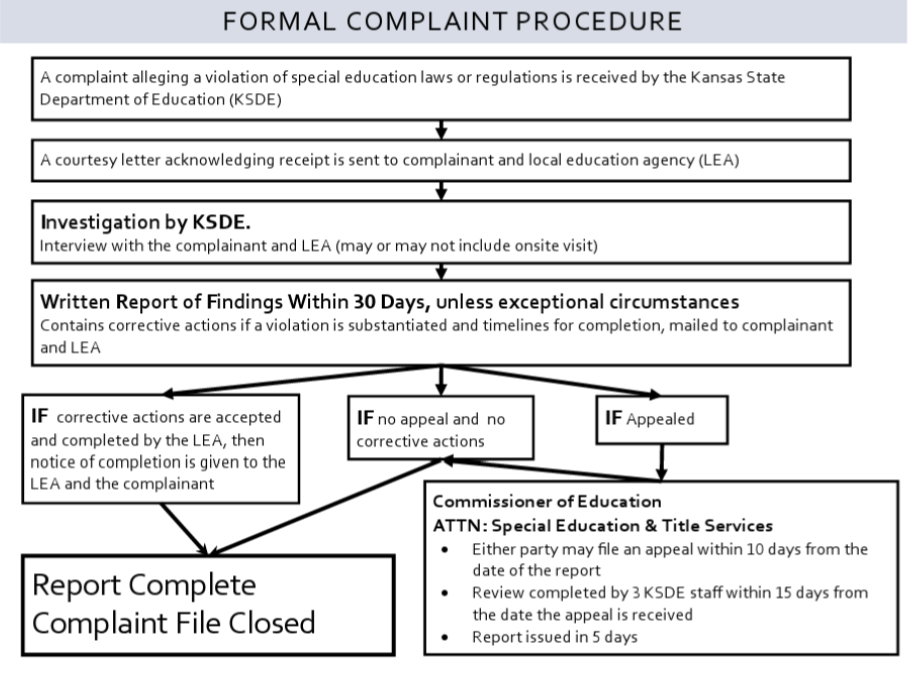
How do I file a complaint about discrimination in a K-12 public school in Kansas?
Kansas State Department of Education
-
Who is eligible to file (students, parents, advocates, others)?
Any person who believes he or she has been subjected to discrimination on the basis of disability in a program or activity administered by the Kansas State Department of Education may file a grievance under the following procedure: (See 504 Grievance Procedure.)
Grievances must be submitted to the Section 504 Coordinator within 30 calendar days of the date the person filing the grievance becomes aware of the alleged discriminatory action.
A complaint must be in writing, containing the name and address of the person filing it. The complaint must state the problem or action alleged to be discriminatory and the remedy or relief sought. See complaint form here.
The Section 504 Coordinator (or his/her designee) shall conduct an investigation of the complaint. This investigation may be informal, but it must be thorough, affording all interested persons an opportunity to submit evidence relevant to the complaint. The Section 504 Coordinator will maintain the files and records of the Kansas State Department of Education relating to such grievances. The Section 504 Coordinator shall maintain the confidentiality of the person who files a complaint.
The Section 504 Coordinator will issue a written decision on the grievance no later than 30 days after its filing.
The person filing the grievance may appeal the decision of the Section 504 Coordinator by writing to the Commissioner of Education, Kansas State Department of Education, within 15 days of receiving the Section 504 Coordinator’s decision. The Commissioner of Education shall issue a written decision in response to the appeal no later than 30 days after its filing.
The availability and use of this grievance procedure does not prevent a person from filing a complaint of discrimination on the basis of disability with the U.S. Department of Education, Office for Civil Rights, 8930 Ward Parkway, Suite 2037, Kansas City, Missouri, 64114, (816) 268-0550.
Are there other administrative processes someone may have to exhaust before initiating a complaint? (i.e., going through school’s, district’s, or other agency’s process first, etc.)
No.
How to initiate the process (relevant websites, standard forms, submission locations)
The complaint must state the problem or action alleged to be discriminatory and the remedy or relief sought. A form complaint is available.
Can complaints be filed anonymously or confidentially?
No. A complaint must be in writing, containing the name and address of the person filing it.
Are there language access requirements for complaint processes?
Are there known barriers to accessing enforcement (filing fees, documentation requirements)?
Grievances must be submitted to the Section 504 Coordinator within 30 calendar days of the date the person filing the grievance becomes aware of the alleged discriminatory action.
Can complainants have advocates or legal representation?
N/A
Are complainants entitled to legal representation or other advocates to file or at any point in the process?
N/A
-
What are the required elements of the civil rights claim?
A complaint must be in writing, containing the name and address of the person filing it. The complaint must state the problem or action alleged to be discriminatory and the remedy or relief sought.
Who reviews claims and what timeframes apply?
The Section 504 Coordinator (or his/her designee) shall conduct an investigation of the complaint. The Section 504 Coordinator will issue a written decision on the grievance no later than 30 days after its filing.
What type of investigation may occur?
The investigation may be informal, but it must be thorough, affording all interested persons an opportunity to submit evidence relevant to the complaint. The Section 504 Coordinator will maintain the files and records of the Kansas State Department of Education relating to such grievances.
Who participates in investigations?
The Section 504 Coordinator, all interested persons.
Are complainants entitled to a hearing of any kind? If yes, what are complainants entitled to during the hearing?
No.
What privacy/confidentiality protections exist?
Yes, the Section 504 Coordinator shall maintain the confidentiality of the person who files a complaint.
Are school districts required to publicly post civil rights complaint procedures?
-
What is the appeals process, if any?
The person filing the grievance may appeal the decision of the Section 504 Coordinator by writing to the Commissioner of Education, Kansas State Department of Education, within 15 days of receiving the Section 504 Coordinator’s decision. The Commissioner of Education shall issue a written decision in response to the appeal no later than 30 days after its filing.
Are remedies legally enforceable once a violation is found?
NA.
Are there other administrative processes that must be exhausted before taking legal action?
No.
Do state agencies publish complaint outcome data?
No.
What enforcement mechanisms exist for non-compliance?
NA.
State Attorney General Enforcement Actions
-
Has the AG taken civil rights actions involving education in the past 5 years?
Attorney General Kris Kobach sent letters to six Kansas school districts challenging their policies that require or allow school district staff to conceal from parents a student’s “transgender” or “gender non-conforming” status. The policies allow schools to “socially transition” students without the parent’s knowledge or consent. ( See News List, School Districts "Socially Transitioning" Students without Parental Consent, Despite AG warning, February 8, 2024.)
What enforcement powers does the AG possess in education-related cases?
Limited. The attorney general or a district attorney (only Douglas, Johnson, Reno, Sedgwick, Shawnee, and Wyandotte counties have a district attorney) may enforce the provisions of the Student Data Privacy Act pursuant to K.S.A. 72-6317.
Does the AG accept individual education civil rights complaints, or does the office only take on broad investigations? (if they do individual complaints, would want to answer the below complaint process questions for the AG’s office)
Yes.
-
Does the AG have an office/section dedicated to education or education civil rights issues? (If the AG has sections or offices dedicated to education or children's rights issues, please identify that office when responding to relevant questions above and with respect to the complaint process below.)
No.
Other State Enforcement Systems
Attorney General of Kansas
-
For any alleged violation of the Student Data Privacy Act, citizens in all countries may file a complaint with the Office of the Attorney General through a form available here. A parent or guardian may file for citizens under 18 years of age.
-
NA.
-
NA.